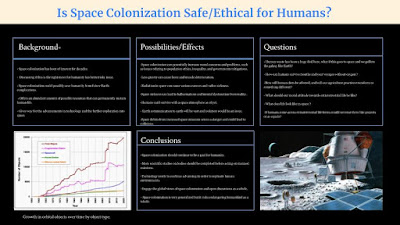
During my second unit of my STEAM course, Frontiers, we've explored the skies and beyond. We have been looking into space like a book with endless possibilities, we dove headfirst into the details. We time-traveled to the past to understand how ancient civilizations came to embark on the mysteries of our skies. Many identified celestial beings as gods. These include the moon, sun, stars, and even Earth's weather cycle. Fast forwarding, our class read two fascinating books/articles on astrology and learned some basics of Kepler's Law which was very interesting. I found out a lot and there's still a lot more to be uncovered. Overall, this unit went by quickly. Trying to keep up wasn't easy but I stuck with it. For this action project we were asked to make a conference-style poster board based on a grand challenge of our choosing. Here’s the one I picked below and my board hope you like it.
Grand Challenge Create self-sustaining and reliable human environments and habitats that enable the permanent colonization of space and other planetary surfaces.
CIted Sources Justin Evans,- Ethical Dilemma of Space Colonization. Lecture.
Kovic, Marko. “Political, Moral, and Security Challenges of Space Colonization.” SocArXiv, 11 June 2018. Web.
Mischa. (2017, January 25). Infographic: What happens to our bodies in space? Curious. https://www.science.org.au/curious/bodies-in-space.
Pat Rawlings. (n.d.). Lunar Mission. https://www.nasa.gov/.
Risks of space colonization. Futures | Vol 126, February 2021 | ScienceDirect.com by Elsevier. (n.d.). https://www.sciencedirect.com/journal/futures/vol/126/suppl/C.
In final unit of Endurance class, we learned about completing our personal missions. We also identified the areas a person my be challenged in their lives. Whether that may be mentally, physically, or spiritually. During our experience in this amazing class, we looked up to people who have completed there our personal mission. One woman we watched a movie about sailed across the oceans by herself, while documenting her trails on camera. This helped us to understand the challenges that we all face are similar. It's just that each individual person combats them differently. For this action project, we were asked to make a survival guide for dream/mission. For mine, I shared my plan to become a Veterinarian after high school and the necessary steps I'd have to endure to make the dream come true. Here's my guide below. Enjoy!
In my course, Frontiers we learned a lot about the ocean and how humans have dramatically impacted them and the creatures in it. For this action project, we had to write a literature review based on our selected Grand Challenge. My chosen topic was “Understanding Global Change on Marine Ecosystems”. This project served as a huge challenge for me but I had fun learning more about our world. Here it is below, enjoy!
In my research about how climate change affects marine ecosystems, I found interesting facts about why marine life are affected by people. Carbon dioxide is a chemical produced by greenhouse gases. A few examples of greenhouse gases are fossil fuels, electricity, and transportation. When carbon dioxide is released into the atmosphere, there are a series of chemical reactions that happen. One of the consequences of this chemical lingering in the atmosphere is the danger toward all types of marine life and the chemical changes that are now happening within the ocean. If their habitats are affected by our actions, it puts them at risk of death, decrease in population, and the need to change their environment to survive. Their overall health would be affected too because of the drastic changes to the surrounding environment. But, this would come back to affect human-beings. This could lead to a decrease in supply of fish or other types of seafood fishers need to catch for sale and consumption. Overall, this could affect their food chain, our food chain, and our inhabitance on this planet.
One of the biggest challenges by far for the 21 century has been global warming. The idea that our world is warming has been controversial. In headlines it has been mocked at as” fake news” by our leaders and said to be a hoax. But scientists have proven many times before that the leading cause of the phenomena is from our own actions. There are ways we can decrease and help save ecosystems that are in catastrophic danger. We all play a vital role in helping slow the rate of climate change but only together can this be accomplished. Earth's oceans play a huge role in millions of peoples lives and support an abundance of marine life. Depending on the temperatures within the oceans they can become abnormal and lose key functions to support those lives. A factor that is currently raising attention these last 10 decades has been the rapid increase in warmer oceans and the acidification of these aquatic habitats. But why are temperatures really rising?
The Earth’s oceans reflect only 6% of the Sun’s energy and absorb the rest of the solar radiation. The oceans play a major role in the process of climate change. They release the heat needed to drive the atmospheric circulation, which creates aerosols in the atmosphere. Aerosols, also known as clouds, are particles created from natural sources, like oceans and volcanoes, while other aerosols are from industrial pollution. They stay within the atmosphere and help cool down the planet by reflecting heat back into space, but not all clouds do this. Thicker clouds reflect sunlight and heat back into space, which usually cools down the earth. But, thinner clouds tend to absorb this heat and reflect it back down into the earth, making the planet warmer. Clouds are able to hold the heat even throughout the night when the Sun is away, continuing this warming effect(NASA Science/Climate Kids 2021, May & June).
The heat that the ocean absorbs from carbon dioxide not only warms the ocean, but causes ocean acidification. Ocean acidification has been an issue for more than 30 years. It’s lowered ph levels are caused by high levels of carbon dioxide in the atmosphere. We may not think that our carbon footprint on land has much of an effect on marine life but it has a major impact.
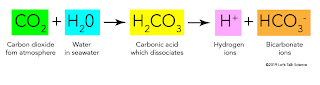
The rate at which CO2 is absorbed is 30 times faster than what it would be without human interference. According to One Green Planet, “Ocean acidification harms coral, plankton, shellfish and other species that use calcium carbonate to help form their shells and skeletons. Plankton and shellfish play an important role in the ocean’s food chain, so when one species suffers, all suffer”(Pittman 2017). When carbon dioxide and the ocean(H2O) combine, they create carbonic acid through this chemical reaction. According to the United States Environmental Protection Agency, “ The resulting increase in acidity changes the balance of minerals in the water. This makes it more difficult for corals, some types of plankton, and other creatures to produce a mineral called calcium carbonate, which is the main ingredient in their hard skeletons or shells”(EPA 2021, May 21). This chemical actually hinders shell growth from aquatic mollusks. Mollusks use their shells for shelter, protection from predators and strong currents, and to help camouflage other animals. Without their shells, this type of marine life is consequently in great danger. Other species like fish are also affected. The fish will try to adjust to the surrounding environment and come into balance with the carbonic acid. This can cause acidosis in fish, when the ph levels in their blood change too(Littschwager 2018, April).
According to the Nation Ocean and Atmospheric Administration, “Certain fish's ability to detect predators is decreased in more acidic waters. When these organisms are at risk, the entire food web may also be at risk(NOAA 2021, February 26). Other species like tuna, marlin, swordfish, and sharks would be affected by deoxygenation from the decreasing amount of oxygen in the ocean. Some animals may be able to adjust to these overtime environmental changes, but oxygen plays a vital role in survival for this kind of life. Because these types of species come in large sizes, they will be forced into increasingly narrow surface layers of oxygen-rich waters opposed to environments with poor oxygen levels(International Union for Conservation of Nature).
The main factor contributing to the harm to marine life is climate change. Climate change is mostly caused by human activity, but can be slowed down or decreased by a few methods. A few ways to reduce climate change are using stopping deforestation, using less energy, and using Negative Emissions Technologies(NET). Cutting down trees worsens the level of CO2 released into the atmosphere. If we start encouraging planting more trees(afforestation), this will restore the balance of producing more oxygen(O2) instead of CO2. Another way to reduce energy use is to use LED lights instead of halogen or incandescent light bulbs. While all of these options provide a light source, the electrical energy in halogen and incandescent bulbs convert into heat rather than light. Also, incandescent light sources contain mercury, and can be environmentally damaging if it is not disposed of properly.
Solar panels, wind mills, and nuclear energy are all ways to conserve energy in your homes and within the community. Things like using cool water instead of warm when washing laundry can help conserve energy. About 75% of greenhouse gas emissions are produced from a single load of laundry that uses energy to warm up the water; but, studies have shown that using cool water is just as effective and that there is no need to use the energy from warming it up. Negative Emissions Technologies help take out CO2 from the air. Technology like solar geoengineering, which reflects the Sun’s energy back into space can help slow down the warming of the earth. One of those techniques are “Direct Air Capture.” Something even as simple as carpooling, walking, or turning off the faucet when the use is not needed can make a major difference not just to our environment, but marine ecosystems and the prosperity of the earth.
Works Cited
As a masters student in the Department of Oceanography at Dalhousie University. “What Is Ocean Warming and Why Does It Matter?” Let's Talk Science, 23 Aug. 2019, letstalkscience.ca/educational-resources/stem-in-context/what-ocean-warming-and-why-does-it-matter.
The Ocean Portal Team Reviewed by Jennifer Bennett (NOAA). “Ocean Acidification.” Smithsonian Ocean, 20 June 2019, ocean.si.edu/ocean-life/invertebrates/ocean-acidification#:~:text=While%20fish%20don't%20have,by%20taking%20in%20carbonic%20acid.&text=It%20can%20also%20slow%20fishes,may%20also%20affects%20fishes'%20minds.
Pittman, Arianna. “How the Warming of Our Oceans Is Impacting Marine Animals.” One Green Planet, One Green Planet, 29 Oct. 2018, www.onegreenplanet.org/environment/oceans-is-impacting-marine-animals/.
US Department of Commerce, National Oceanic and Atmospheric Administration. “What Is Ocean Acidification?” NOAA's National Ocean Service, 1 Aug. 2012, oceanservice.noaa.gov/facts/acidification.html.
In our second unit of Endurance we were introduced to our Action Project, which was a 12-hour challenge. The main goal of the project was to see if we could stay consistent and dedicated to our chosen topic and document it for others to see. For my 12 hours, I decided to draw for the duration of the time. I had thoughts of recording my workouts and making beats, but drawing stuck out because it was less of a hassle and flows easier for me. It felt more like a hobby and would be more fun to do. My mission overall for the project was for me to explore art. I love to draw and I don't do it as much as I did when I was younger, so I wanted to just get back into it. For the project just thinking about what to draw was a challenge itself. It slowed me down in the process but helped me later. After deciding what to draw, my good friend stuck out to me. I looked at it and was like “that’s the one”. So I got to it.
Along the course in Endurance we learned about different people and what they had to overcome. Many obstacles were thrown their way and all types of difficult situations. One of my biggest obstacles was accepting the fact that I needed to slow down and erase if I had to. These are my main challenges whenever I draw. I never like to erase or start over and in return I get an okay drawing. I'm not satisfied with how my art came out but I would say it's alright. If I could do this again I would not draw people. Assuming this in the beginning, drawing isn’t as easy as it looks and I took that for granted. I have a long way to go to get better at drawing and this was just a start.
Hour
Intention (What will you be doing?)
Date, Time
Entry (reflection, question, connection …)
1st
I started to clean off my desk and organized my selected materials. I also began pulling up reference photos of people or things I wanted to draw.
5/5/2021
3:00-3:25 pm
I realized that today I have a unique taste of colors and a medium that I go to. It’s random and off the top of my head.
2nd
Today I’ve placed out all my materials and sources that I’d like to use for the duration of my 12 hour project. I had so many options I became overwhelmed.
5/6/2021
5:00-6:00 pm
Figuring out what to draw was challenging. I had to figure out what I was passionate about and what would keep me motivated to continue this journey. I wondered why this part was so hard? Before in the past I would pick anything and it would be good. Now it’s like my creativity is slowing down.
3rd
I began planning out the scale of the drawing and how big I wanted it to be. I first assembled the paper into comic-like strips. Then added heads to resemble my chosen reference picture.
5/7/2021
3:00-3:45 pm
For this part, I really had to endure and not freak out. So I began to sketch out circles on a page and decided to go small for this project. In the past I’ve tried to go big or go home and well, let’s just say that didn’t work out. This reminded me of David Blaine when he had to prepare before his stunt. He had to go overtime to figure out what made sense to get the best outcome with his overall mission. His situation was very difficult but he overcame it with the help of others' knowledge.
4th
Today, I started sketching the outlines of heads and tested colors I wanted to experiment with in my drawing.
5/8/2021 6:00-9:00 pm
I had trouble mapping out how I wanted to configure my space within my sketchpad. Then suddenly a question came to my head. Why don’t I freehand draw? I seemed to be alright at it. So I think I’ll give it a shot.
5th
I began to draw my selected reference photo and added some basic anatomy of the head from my reference.
5/9/2021
2:00-4:00pm
By drawing people I was going in blind. I have never been good at drawing realistic faces and this began to slow down my fast pace style of drawing. I kind of learned to have more patience while being resourceful with materials.
6th
Added details. Shading, blending, line work
5/10/2021
11:00am-12:00 pm
So today I noticed that I’m slowly advancing and liked how good the drawing is coming along, but the image did not fit to look real. So I started to contemplate whether or not to start over. I didn't but just thought to myself what if I made it cartoon-looking.
7th
Today I took a short break to get some inspiration. I walked outside for a moment then visited Youtube and watched videos on how to draw realistically.
5/11/2021
6:00-6:15 pm
I took a day off of drawing and focused on what I was doing wrong. I reflected and I thought I rushed my drawing because of how it looked at the halfway point. I just had a hard time accepting the work I had done.
8th
I added some more shading, painted, highlighted, and outlined the faces and background with an abstract pattern. I also added different word fonts and objects around the drawing.
5/12/2021
1:00-4:00 pm
This process left me feeling drained. I drew for 3 hours straight taking short breaks in between, but my hands began to cramp. I’ve drawn before for longer periods, but it’s been a while. The short pain in my hand reminded me of how Elie endured after he had gotten beaten in the last chapter of Night. It wasn’t anything extreme, but I would say that it hindered the potential my drawing could have had. Thankfully, I powered through it and completed the task.
For my humanities course called Endurance, we have started to look at what it means to overcome hardships. We have studied many examples of heroic and inspirational figures in history that have done the impossible and faced much adversity in their lifetime. Some included people like Nelson Mandela & Gandhi. These figures all had key things that made them all similar, they endured till the end. They didn’t give into the temptation of quitting on their missions and succeeded. These past two weeks my classmates and I have been doing self-analysis as to what we aspire to in life. Our dreams, goals, and careers we want to pursue in the future. We’ve even gone as far as making our own personal mission statements, which was very hard. For me, I had to dive deeper into myself and actually acknowledge the things about myself that I like to deny. It helped me to humble myself and see that I have much more to uncover about myself. For this Action Project, our objective was to write an autobiography about our lives in the future 30 years from now. Here it is below, enjoy.
Born Friday the 13th on September of 02’, Jahsia or JJ was born in Chicago, Illinois. I was a very bright child. I mean that in the least corniest way, but when I came out I was literally white and my mother was like “this ain't my baby”. The nurses reassured her that I was hers. My eyes at that time changed for a while so I didn’t have a color given at birth. They later settled and became a beautiful hazel-brownish color. In the sun they stand out and the rays make them look greenish. They remind me of my grandfather's eyes. I was born a tall baby but I didn’t weigh a lot, I was a good baby, didn't cry that much, and only desired to be held by my mother. From a young age, I’ve always been creative and adventurous. Always wanting to explore and learn more and more. Those days as a child were like the best and the worst moments for me coming up.
During elementary school as a kid, I was very shy and quiet. Interacting with lots of other children made me feel awkward and uncomfortable. But I did enjoy having an occasional buddy or two in my circle that I would hang out with. These people over time encouraged me to talk more and be myself. Before going into school I would always hide behind my mother whenever someone talked to me and would never look people in the eyes. But one day a teacher had a talk with me about respecting adults by looking them in the eyes. At first, I thought it was really weird. It made me wanna run away like I had ants in my pants as an excuse to leave. This helped me later on though and I wish I could thank that teacher. Living on the Southside of Chicago was interesting as a kid. From a younger perspective I didn’t understand race or segregation, but I noticed when going where more white people lived had nicer things and more options to do funnier things. Race was something brought to my attention when I was about 8 or 9 and I was very confused that somebody would hate me because of my identity. Well that made more sense considering the first thing I was taught in middle school was, I was bought and sold like cattle. This blew my mind and changed my entire view of certain people. Kinda like Neo finding out his life was a simulation.
Moving along as a younger me, I was introduced to the Boy Scouts. I liked their neat uniforms and how they marched in formation. I thought it looked cool so I joined. When I joined I had begun learning about the scout law and the oath as how I was supposed to live. Scout Law: “A Scout is trustworthy, loyal, helpful, friendly, courteous, kind, obedient, cheerful, thrifty, brave, clean, and reverent.” The law helped me learn to respect and care for others even if I didn't know them. This impacted my life tremendously as it taught me patience and how to live a morally straight life. Without the Scouts, I wouldn’t be who I am today and I’m thankful for all my leaders in my troop who supported me along the way.
Shortly after Boy Scouts, I was introduced to basketball and tried out for the middle school team. I fell in love with basketball. To me, basketball was like my counselor when I played. I let everything in my mind go blank. Playing basketball became more and more serious over the years from middle school to travel teams and high school tournaments. It was like that one rollercoaster at Six Flags that you never wanted to get off. But everything wasn’t all sunshine and rainbows. Eventually, things started to become sour as a Warhead and the dark clouds rained on my shine. Around this time I had started to display signs of depression. In the beginning looking back it had a lot to do with family issues. This mental hurdle I faced ultimately could have destroyed me. I didn't let that happen though. I stuck with focusing on the good and ignoring the bad. I would tell myself it could be worse and to be thankful for all I had because I knew that it could be taken away in an instant. So art came into play in my life, music influenced a change in my mood, and basketball practice/games allowed me to break free from my bondage.
Graduating high school was a relief but also like a dream come true because it happened so fast. I made it through those long days and I was proud of myself. But what was I gonna do in this next chapter of my life? The question would revolve around me like a spinning globe 24/7. It stuck in the back of my mind like a sharp thorn until I found my purpose. In my early 20’s, I started to play in a band in college. I would practice every day on my guitar after lectures. This turned into an overnight passion. I began to find inspiration in music. I’ve always been into art all through my younger life so music came to me naturally. Understanding that a 9 to 5 job wouldn’t satisfy me, I quit my job and started to perform gigs after about 5 years. I then began to record myself during live events and upload videos to Youtube. My band and I began to haul in thousands of dollars from our views. We gained attention from large record labels and small radio stations that would air our best songs. During all of this, I had completed my bachelor's in Business Administration at UIC and later moved to Atlanta. Eventually, I signed to Columbia Records and left my band going solo to pursue my music career. I became an overnight sensation making hit after hit. I performed at Rolling Loud, Lollapalooza, and went on tours.
On this glorious journey to fame, I struggled later in my career to write songs. I often had mind fogs and drifted into abusing narcotics to come up with songs. Mentally I was attacked with what felt like demons trying to lure me into doing crazy stunts. At one of my performances, I jumped off the stage and broke my neck. I suffered from my ticks and withdrawals while in the hospital and also had a neck brace. During my time in the ER I went to rehab and physical therapy. I can say these things all happen for a reason and made me want to clean up my act. Some days I felt like giving up but I found God along the way and He opened doors to my healing. After my traumatic incidents, I turned a new leaf and writing songs became easier as my mind cleared. My music went platinum and I became an award-winning artist. My songs expressed my trials and tribulations of how I overcame them. These influenced people all around the world as I became an inspiration for rehabilitation for those with addiction. I started a foundation that dedicated time into supporting lost souls who need comfort and compassion. The foundation was called Free Spirit.
Towards the end of my career, I met a woman and we got married. She was as beautiful as the morning sunrise. We were not only lovers but best friends. A figure in my life that I thought I could relate to was Jimi Hendricks. He was a guitarist in the early ’60s who rose to fame like me. He lived a short life, but he faced similar challenges of drug usage as a musician. Over these past 30 years, I’ve learned how to endure and tackle obstacles that made me a better person for myself and others around me who I impact. Every experience has taught me a lesson and I wouldn’t change how it happened.
During Social Entrepreneurship this year, we've learned a lot. We explored many different types of businesses and discussed what actually makes a business stay afloat. Recently we had a guest, Matt Nicklin from First Analysis, who shared some informative knowledge about his company. We dove deep into the mind of a capital investor’s job and we tried to ask tons of questions. I enjoyed learning how his corporation runs. In Social Entrepreneurship, we’ve worked diligently to learn how to make a business plan. We gazed over things like target audience, mission statements, and roles of a business. I found that all great businesses have three keys to success: loyal customers, consistently great customer service, and great strong relationships built within the organization. For this AP we had to come up with our own business and create a plan that had a social impact.
During this second unit of Equality, we have dived deep into the true meaning of equality. We also searched for ways to make equality achievable and in a timely manner. We looked at many different categories that this can be separated into. These included class, gender, and race. From analyzing data of women being underpaid to common biases and stereotypes, we’ve just about covered it all. I learned so much during our time in this class and the time flew by. From my studies in this course, I’ve learned that there are many ways to look at the same subject. But it takes action and people coming together to make a difference for the greater good of humanity.
Breaking News- The Education Gap Has Gone Extinct!!
Through the turn of the century, as a nation, we have faced many challenges and have overcome few critical issues that make a broader impact on society. We have seen progress and we have learned to adapt to new ideas brought from minorities. As of 2020, there has been an awakening for the injustices done to African- Americans by systematic oppressors. After the murders of George Floyd, Breonna Taylor, and many others killed in the past, people from all walks of life have come together to protest and strive for the basic human rights of black people. See, history tends to repeat itself but this time around there will be a change in circumstances. (*Amen*)
Along with this lingering history of disenfranchisement to black’s education, this stems the root of the problem in America’s financial disparities. Knowledge is key to knock down these walls that have been set in place for black’s. 79% of blacks have a high school diploma, 26% have a bachelor's degree. And about 60% drop out of school altogether. Compare this to white counterparts who have a high school graduation rate of 89% and a 62% graduation rate out of college. Higher education allows access to greater opportunities for good-paying jobs. These jobs accumulate triple the net income of a minimum wage family. Leading to more generational wealth for whites and most likely debt for blacks. The proof of educational inequalities are there. The question is how do we combat it? For starters, implementation of a similar curriculum for all students in all districts could work. By allowing underprivileged students access to state of the art technology and classroom resources where education can be expanded outside of a textbook, students will be able to use these opportunities to excel in their studies. This would motivate students to stay engaged, participate, and ultimately lead to grades improving.
Secondly, eliminating district separation and school segregation can expand the limitations set on what type of education a student wants to pursue. A school in a neighboring district may not be suitable for all students in that area. If a choice is given to decide where someone would like to receive their education, why would this choice be shut down or dismissed? Once a student is able to make this choice they can receive a similar or even better education from the school district they came from.
Finally, free education for private schools and free aid/tuition is a must! Without the foundation of reliable income in the household, managing other responsibilities can be discouraging to attend or even apply to certain schools. If school were free including colleges and universities it would destroy the gap between races finishing college. It would set a pathway of advancements to an abundance of different careers. Altogether this could round out the wealth gap, create equality for all races, and demonstrate true equality.
Company: Head Over Shoulders. Inc
Specializes in Graduation Attire
Sale Starting at $65.95
Cap/Gown: Crosses out black people in prison. Showing an end to the school-to-prison pipeline.
Higher education leads to fewer people in prison.
Policy: As of 2120, I hereby declare all private sector institutions to teach at a national standard. This implementation of an equal curriculum will increase the chances for people of color in succeeding in their near future. - President, Squarepants
“Over the course of my life, I have seen a difference in school systems in Chicago and in other major cities. It is currently the year 2120 and I’m now an 18-year-old Senior preparing to graduate this spring. During my time in high school, I felt like my teachers were there, but their passion to teach wasn’t. I’d go to class everyday thinking: is it even worth coming here if I’m not going to learn anything beneficial to my education or my future aspirations? I really did want to go to college this year, but it’s frustrating to want to seek the opportunity and not be able to reach it because of what district I’m in. If I go to college and graduate, I’d be a first generation college student in my family. That would be a big accomplishment for me and I really want to make my mom and my sisters proud. I’m the firstborn, so by example if I can do it, any one of them can dream and achieve! I’ve always been interested in the art of barbering and where I could go with it. I could always watch some more videos on YouTube to give me a leg up, but that isn’t exactly gonna get my name on the top of the “we should hire them” list for a professional job. One day, I’m going to open up my own shop. Recently, President Squarepants passed a policy I know would definitely help me a lot. I feel like I have a chance to succeed if I do choose to go off to college. This new policy is said to be incorporated into all schools, this includes elementary, high school, and college. Its impact would help me gain better access to schools that can accommodate to my needs. I can now openly apply to colleges without the feeling of despair. I can now keep my head up knowing that my education will be the same as other races. This will benefit not only me, but future generations to come and will help black people like me to achieve success. I approve of this policy and I will definitely be backing this new legislation.”
In my second Humanities course called Equality, we spent the last few weeks discussing issues of race, gender, and class. We learned about redlining in Chicago in the early 60s. We learned about the struggles and the strengths of the powerful woman suffrage movement. Then we looked at what makes class and what classes are there in our society. Also how class, gender, and race can affect the quality of your day-to-day life. For this action project, we were tasked to come up with our own interpretation of a page in a school book and make it our own. We did this by providing the historical context of a marginalized group of people whose voices aren't heard. My page focuses on African Americans' perspectives on policing in their communities and neighborhoods. How it impacts people's lives today and in the past. Here I dug deep to find the root into the historical events of policing and to obtain the perspective of African Americans who have been inflicted with wounds from countless years of cruelty. Here's my slide below.
In Unit 1 of my class System and Models, we dove deeper into ourselves for the first 2 weeks of class. Looking into various personality tests and research studies. I found out that I am a logistician, meaning I’m someone who is introverted, intuitive, and often rely on facts before making decisions. As the entire class established ourselves we started to gain a perspective of one another by choosing a picture that represented our lives in one photo. Down the road, we shifted towards focusing on groups’ perspectives when it came to engaging wants and needs to be met. A huge role in this was provided with Maslow's hierarchy of needs. This ultimately provided us with the resource to look upon when we needed to adjust to our chosen aspects we’d like to innovate.
We then made our way to the best working groups for business management. This included Baldridge. Six Sigma. And Total Quality Management. And finally, we learned about Commons and SWOTs. For my aspect of GCE to work on, I decided to challenge myself for the courses for those with Musical interests and concerns. I found that we could go above and beyond, and test out new ways to implement music through the school. Here’s my slide show below enjoy!
Hi, welcome to my AP for “Music that Matters''. During the course, we talked about music and asked ourselves, is it important? We also learned how to break down a song and listen without objectively. We listened to many examples of various kinds of music from different artists. For our field experience, we had guests with musical backgrounds join us on Zoom. They all shared their experiences of music in different ways. They also shared either how music has helped them or benefited others around them. For our AP, we are creating proposals for My Block, My Hood, My City. The question that will guide us is, "How can music contribute to our neighborhood?"
For my musical installation, I decided to have my event take place virtually. It consists of various artists on a playlist broadcasted to the residents of my community's devices. The assorted songs all have the genre of Hip-Hop. I understand that in my neighborhood rap is mostly played and it could be beneficial if it was giving off positive messages. My installation will alert residents on their devices of the list of songs that are about to be played. They get the opportunity to opt-out after the first song, but it forces the listener to hear the powerful messages in the song. For optimizing the listener’s experience a pair of headphones would be crucial. The headphones would allow you to capture all the sounds happening and you can even feel the vibration of the rhythm. My installation resemblance is close to an Amber Alert. I did this intentionally to internally shock my black people in the hood. This route forces our self-consciousness to change our perception of certain topics that seem too difficult for us to talk about. It also seemed the best option due to COVID-19. What’s the location? Well, it’s going to vary depending on where the people are, hopefully, they are in their homes. The broadcaster transmission for the installation would only go to the people in my neighborhood and not all of Chicago residents.
Here I understand that in my area black people face many disadvantages and unequal opportunities. Often we are dismantled by drugs in our community and traumatized by violence from our own. One thing that I always hear playing around is rap music. Raps that are being soaked into the brains of the youth, which impacts the future generation and the world. My idea is to reverse toxic material into a positive and uplifting array of immersive affirmations for black listeners. It’s something they can go to when they need motivation. This would alter people's thinking and with luck their actions also. The installation itself will ignite people by exposing the truths that we deny. It will teach listeners by proving details of historical events they might not have known. Last it will inspire the adults in the community to change their ways and so the youth would follow.
When analyzing the music from a Ratliff’s perspective I view the music as loud in the sense that it gets its point across and there are also changes in direction of the songs. Theres repetition in the choruses and also in some verses. As they repeat a rhyme the flow seems to stay the same for that moment, but it alters later in the song. For example, “just to get by” repeats multiple times.
All of the artists also are well known for their unique flavors of rhyme scheme and poetic touches. This is what we called having virtuosity. Basically meaning standing out in the ability of performance. While listening I hear lots of authority in the artist's voices. They displayed confidence and passion in the lyrics. So well that you can feel it. Here I also find exclusivity and I find that rap music isnt alot of peoples go to. Also, the messages in the music might not relate to what everyones accustomed to. I want to say that hiphop is what most blacks listen to and also black people invented it. Then last I can describe there way of freeforming words at random to make any track as special. Many of these artisit have been known to freestlye and use improvisation in their music. Improvasation meaning something done without a particular order.
The songs I picked are from the early 1990's to 2000's. During this time I feel Hip-Hop was more powerful with its messages and impacted lots of people. During the 90's era and early 2000's there was of course gansta rap and trap music, which still plays a role in culture today. The meter of the playlist I belive is 4/4 and the tempo is around 90 to 115 bpm. I feel that at this pace of speed it allow people to take in whats being said. They also can enjoy the beat of the songs while learning and becoming enlightend of something new.
Overall my installation is meant to wake up black folk in my neighborhood and help promote some type of influence or change. The idea might go to far out of boundaries but I liked it so I stuck with it. From this course I have learned that music does matter. Music can be a tool and a weapon it has no right or wrong. Music can bring people together and it can help a cause.
For my Journalism course, we had to pick an influential voice that has made an impact on our own lives, and the people around us. We were tasked to produce a podcast about them. The voice I chose was Malcolm X, a “Black Nationalist Freedom Fighter”. He and others played a very important role in the Civil Rights Movement knocking down doors for the future youth. Malcolm X was known for his furious speeches that sparked the hearts of millions. Not only here in the United States but globally. As a Minister for The Nation of Islam, he provided knowledge for Muslims and blacks in general on how to defeat the oppressors. In his words the “blue-eyed devils”. During his short life, he worked towards fighting racist injustices and decent human rights. Although he took a different approach on violence he never encouraged it. But he never backed down from a fight. Whether that be political or somebody trying to burn his house down in the middle of the night. Anyway, my podcast is below enjoy!
0:00
0:01
0:43
1:36
3:50
3:52
4:20
5:00
Jahsia
NWA
“Fuck Tha Police” plays in the background
Song fades out
(1964) Malcolm X’s Speech
“The Founding Rally of The Organization of Afro-American Unity”
Jahsia
Erin
Geto Boys
“My Mind Is Playing Tricks On Me” plays in the background
Jahsia
Mobb Deep
“Shook Ones”
plays in background
Nakiya’h
Jahsia
Hello and welcome to my podcast. Today I want to talk about someone who is vital to our history both then and now. Malcolm X has been an essential part of the Civil Rights movement and achieving fairness for people of color. He used his words as an encouraging outlet for others to hear and feel motivated by. For others to take action and stand up for what they believe in. And for others to love their black beauty and speak straightforwardly about what change should look like.
So we have formed an organization known as the Organization of Afro American Unity which has the same aim and objective – to fight whoever gets in our way, to bring about the complete independence of people of African descent here in the Western Hemisphere, and first here in the United States, and bring about the freedom of these people by any means necessary. That’s our motto.
What do you think about Malcolm’s approach to achieving freedom?
I think that [Malcom’s] approach I don’t think it was a bad thing people may have thought that it could’ve been maybe something under a negative light because it wasn't as soft or wasn't an approach like MLK’s. His approach was a good approach too, it was peaceful and it was bringing togetherness among everybody. Malcolm too I feel like that was the entire goal. The entire goal is to have equality, to have freedom for all, for there to not have that tension because someone is a different color skin than you. But I think that the way he went about things was good; like sometimes for people everyone has a different mindset, everyone's raised in a different way and come from different homes. So sometimes things have to be said differently to really soak into people’s minds so really having those words of wisdom to be a leader and really have that ambition and passion that you really want to change something is influential in itself. All you would have to do is say the word and everything else will spread like fire if people are able to be open-minded to going about things in different ways or saying things to each other differently. That want for change is the beginning of how change can even commence so I feel like he was one of the people that were really able to set in place to start that ignition for that fire to spread
Do you find Malcolm to be inspiring to you? Why?
Yes, I do find Malcolm X to be very inspiring. He and his work and organizing as a black activist is commonly referenced in English and USA history studies. I feel that most black activists today in America most likely have been provoked to act in their work through his examples he had set.
Malcolm X was an important figure, without him we wouldn’t have the black panther party, and probably wouldn’t be as many voices speaking up for about Black Lives Matter. He continues to influence lives in the 21st century more than ever. And I believe that black people are now waking up. Instead of pleading for rights we need to take them. Especially with all, that’s going on. “By any means necessary”! Thanks for listening peace!
In this term in Economics, we jumped into our course by looking at Kate Raworths, Doughnut Economics. In the book, Raworth talks about the seven ways you can think like a 21st-century economist. During group work, we read chapter 4, Getting Savvy with Systems, which described the difference between simple systems that are bound to change, and the new adaptive-complex system that in turn should be used. Kate goes on saying the markets should be evolving over time at a constant. For this Ap, we had to basically make up the next chapter of Doughnut Economics using our economic principle. The principle should connect to the book or an SDG to impact the world’s economic outlook and make it better than it is.
Economic principle: Reduce, Reuse & Redistribution Ensure sustainable consumption and production patterns
SDG goal 12 is about how we as a community can reduce the number of waste and still be able to produce to the world using items again. I think that the world is heading towards bad times. Up to ⅓ of the world’s food produce ends up being trash because of poor transitional processes and harvesting practices. We can avoid that by consuming seasonal and local products when they are available in stores. This way we are able to dispose of food in a manner that is safe and healthier for the environment, rather than having many different types of food go bad in stores or have already gone bad when trying to purchase an item. Another way we could contribute to SDG goal 12 is by using LED or low-consuming light bulbs to cut down our electrical consumption rate in this matter by 50%-80%. We could save $120 billion by using energy-efficient bulbs yearly. Purchasing second-hand products can also be a good way to prevent or slow down good items from being thrown away that still have a good use. Thrift shopping, garage sales, shopping on online businesses that sell used goods like Poshmark, or food pantries can be examples of second-hand buying.
Wasting essential products is really harming our environment. The amount of waste that we are producing, it would take up to three earth’s to maintain it all. It would be better for us and for the earth if we could be thoughtful to learn more about it and what one person could do themselves. I believe that it only takes one person to make a huge change.
Richard Adams is an example of how to transport goods while still looking out for the earth. He created a movement of fair trade and set up a business towards food imports in India. This way, people would not be overcharged from intermediate agents attempting to charge more than what a reasonable price should be. As oil prices increased, which made transporting foods close to impossible, Adams used wood and euka as alternatives to this. Here in the U.S. we too can find other ways to benefit our surroundings. We don’t want to repeat living in a “Take, Make, Use, Lose” society, but rather “Reducing, Reusing, and Redistributing” in an effective way.
“...‘doing our fair share’ can too easily slip into ‘taking our fair share’. When many businesses look at the Doughnut they seem to look at its outer ring of planetary boundaries as if it were a cake to be sliced up and handed out. Every business wants a fair share. Still being stuck in an old fashion mindset, linear industry, the first question that many ask is: how big a slice of that ecological cake is ours? How many tons of carbon dioxide can we emit? How much groundwater can we withdraw?. But ‘taking your fair share’ reinforces the view that the ‘right to pollute’ is a resource worth competing for. And when competing over limited resources, we humans too easily start to jostle for space, lobbying policymakers..ers and gaming the system, significantly raising the risk of transgressing the boundaries in the process…”(Raworth 179-180). We have to be careful about how we are choosing to consume and how much of it we are consuming; this varies from food, to clothes, to other necessities as well. If we could invest our money towards cutting down non-efficient sources of electricity, we could cut down finances on spending to produce such that could be harmful vs other environment-friendly ways.
A Sustainable Circular Economy Approach
A quote from the text that I found from Get Savvy says, "It is out of these interactions of stocks, flows, feedbacks and delays,” writes Raworth, “that complex adaptive systems arise: complex due to their unpredictable emergent behavior, and adaptive because they keep evolving over time.” So with these continuing ideas, we make use of then throw away we are drifting far from our SDG goals. Not only are we endangering other life here, but our own life is on the line. These short and odd systems that don't define true character and integrity are driving the sustainable economy to a plummet.
Works Cited
Globalvia, director. Sustainable Development Goal 12 - Ensure Sustainable Consumption and Production Patterns. Youtube, 2 July 2019, www.youtube.com/watch?v=hgNet-a8TFs.
“Sustainable Consumption and Production – United Nations Sustainable Development.” United Nations, United Nations, www.un.org/sustainabledevelopment/sustainable-consumption-production/.
“Chapter 6.” Doughnut Economics: Seven Ways to Think like a 21st-Century Economist, by Kate Raworth, Random House Business Books, 2017.